
Are downsizer contributions losing steam?

Tax Office data shows fewer people used its super scheme in 2024-25

.

Introduced in 2018, the home downsizer scheme allows eligible Australians aged 55 and older to contribute up to $300,000 from the sale of their home into superannuation, outside of normal annual contribution caps.

The idea was simple: improve retirement incomes while freeing up larger homes for younger families.

For eligible couples, up to $600,000 can be taken from their total home proceeds and split equally between their respective super accounts.

Yet, since peaking in 2021–22 when almost 20,000 people made downsizer contributions totalling just over $5 billion, both the number of contributors and the total value of contributions has declined. Last year 15,800 Australians took advantage of the scheme and contributed a total of $4.16 billion into super – the lowest number in five years.


Total individuals and downsizers contributions by financial year
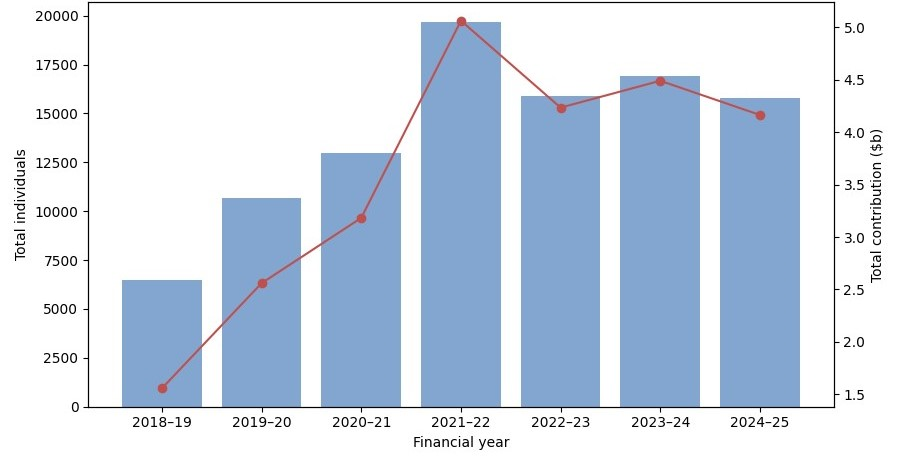
Source: Australian Tax Office


Which leads to the inevitable question: has interest in home downsizing faded?

Not really. The initial rise in downsizer contributions was powered by people who were already planning to sell. For financially literate retirees with strong super balances and little reliance on the Age Pension, the policy was an obvious opportunity and many moved quickly to take advantage of it.

But a downsizer contribution can only be used once in a lifetime. When those early adopters acted, they permanently exited the pool of potential contributors. By 2021–22, many of the most prepared and motivated households had already made their move.

What followed was a predictable plateau, not a sudden loss of interest.


Many older Australians aren’t selling

Downsizer contributions depend entirely on one thing: older people selling homes. And despite high property prices, many are not willing to make the move.

This was one of the key findings in Vanguard’s How Australian Retires 2025 report, which found that less than 30% of retired Australians have moved or are planning to move into a new home since retiring.

In fact, most retirees see their home as something to hold onto either for life or to pass on as an inheritance. Only 9% of those surveyed considered their home a potential source of retirement funding.

For many older Australians, the family home represents stability, security and independence — benefits that rising prices alone don’t sever.


Interest‑rate uncertainty has bred caution

The past few years have also been marked by sharp swings in interest rates and economic uncertainty. While retirees may carry little debt, they are often more sensitive to volatility than younger households.

Selling into a shifting market raises fears of poor timing, unexpected price falls or difficulty securing suitable replacement housing. In that environment, many retirees have adopted a “wait and see” approach — delaying major decisions, including downsizing.


A lack of supply

Another persistent issue is supply. For downsizing to make sense, retirees need access to smaller, well‑located, accessible homes — ideally within their existing communities.

In many areas, that stock is limited. New apartments may be expensive, poorly designed for ageing residents or poorly located relative to services and family. When suitable housing is scarce, downsizing stalls — and so do downsizer contributions.


The Age Pension remains a silent spoiler

Perhaps the biggest structural brake on downsizer contributions is the government Age Pension.

The family home is exempt from the pension assets test. Superannuation is not. When retirees sell their home and move funds into super via a downsizer contribution, they can inadvertently reduce or eliminate their pension entitlement.

This trade‑off is well understood by financial advisers and deeply felt by retirees near pension thresholds. For many, protecting or maximising the Age Pension outweighs the tax advantages of holding more assets inside super.


A mature scheme meets structural limits

The decline in downsizer contributions largely reflects the reality that downsizing is complex, deeply personal and shaped by pension rules, housing supply and risk aversion.

Early demand has largely been met. What remains is a smaller, steadier flow of people who are ready to move when circumstances align. For most retirees, the decision will continue to hinge on lifestyle, certainty and suitability — not just numbers on personal finances.

For more information on home downsizer contributions including eligibility, contribution limits, and how to make a contribution, visit the ATO website.


Vanguard
11 February 2026
vanguard.com.au

Want to know more?

Do you have a question about something you've read in this article? Need more information? Want to book an appointment? Simply let us know below and we'll get back to you ASAP.

General Disclaimer

The information contained on this website is general in nature and does not take into account your personal circumstances, financial needs or objectives. Before acting on any information, you should consider the appropriateness of it and the relevant product having regard to your objectives, financial situation and needs. In particular, you should seek the appropriate financial advice and read the relevant Product Disclosure Statement or other offer document prior to acquiring any financial product.

Dr John Tickell is a registered Medical Doctor, who graduated at the University of Melbourne, Australia. Dr John has spent several decades travelling and researching the eating and living habits of the longest living, healthiest people on our planet.

The author may give opinions and make general or particular statements in this literature regarding potential changes of lifestyle habits based on experience and research. You are strongly advised not to make any changes or take any action as a result of reading or listening to this material without specific advice from your doctor, physician or registered Health Professional.

The author, the Publisher, the Editor and their respective employees or agents do not accept any responsibility for the actions of any person, or injury, loss or damage occasioned - actions which are in any way related to information contained herein.

Opinions and statements in this literature are based on verified research and experiences by the authors and are to be regarded as health and wellness advice.

Privacy Policy

What Personal Information Do We Collect?

The personal information that we collect will depend on your relationship with us and the service(s) you or your organisation have engaged us to provide or are interested in. It may include:

Name and contact information (including telephone and mobile number, email address and residential and postal address);

Individual information (including racial or ethnic origin(s), language(s) spoken, religious belief(s) and affiliation(s), date of birth, age, place of birth, gender(s), occupation(s), employment and qualification details, financial records, income details, asset listings, taxation records, bank account details, insurance policies, medical history, disability status, criminal record and Court records);

Payment and transactional information (including banking and credit card details);

Other personal or sensitive information (including information contained in communications or documents, any information required due to the nature of your matter, or information we are required to or permitted to collect by law).

Collecting Personal Information

HOW WE COLLECT PERSONAL INFORMATION

We may collect your personal information directly from you or in the course of our dealings with you. For example, we collect personal information from you or about you from:

Correspondence between you and us;

Meetings and interviews with us, telephone calls with us, the instructions you provide to us;

Visits to and submissions you make on our website;

Your interactions with our electronic direct mail and/or emails from our marketing campaigns (such as clicks on links included in these emails); and

Registration and forms you may fill in for our marketing-related activities and events.

WHY WE COLLECT, HOLD AND USE PERSONAL INFORMATION

We collect and hold your personal information for a variety of purposes, and you permit us to use it:

To provide you with our services and carry out our business functions;

For purposes related to the provision of our services such as , educational briefings, seminars and coaching and other service offering updates, conducting client satisfaction surveys and feedback requests, statistical collation and website traffic analysis;

Where you have consented to its use or disclosure;

Where we reasonably believe that use or disclosure is necessary to lessen or prevent a serious, immediate threat to someone's health or safety or the public's health or safety;

Where we reasonably suspect that unlawful activity has been, is being or may be engaged in and the use or disclosure is a necessary part of our investigation or in reporting the matter to the relevant authorities;

Where such use or disclosure is required under or authorised by law (for example, to comply with a subpoena, a warrant or other order of a court or legal process);

Where we reasonably believe that use or disclosure is necessary for the prevention, investigation, prosecution and punishment of crimes or wrongdoings or the preparation for, or conduct of, proceedings before any court or tribunal (or the implementation of orders of a court or tribunal or on behalf of an enforcement body);

To develop and improve our business, products and services; and

For any lawful purpose.

Where we wish to use or disclose your personal information for other purposes, we will obtain your consent.

HOW WE HOLD AND STORE PERSONAL INFORMATION

Your personal information is held and stored on paper, by electronic means or both. We have physical, electronic and procedural safeguards in place for personal information and take reasonable steps to ensure that your personal information is protected from misuse, interference, loss and unauthorised access, modification and disclosure:

Data held and stored on paper is stored in a secure premises.

Data held and stored electronically is protected by internal and external firewalls, high encryption and all access to electronic data including databases requires password access

Access to personal information is restricted to staff and contractors whose job description requires access. Our employees and contractors are contractually obliged to maintain the confidentiality of any personal information held by us.

We undertake regular data backups, with the data copied and backed up to multiple locations for redundancy purposes.

Our staff receive regular training on privacy procedures.