
Magnificent Seven: More diverse than they may appear

The Magnificent Seven are more diverse businesses than their shared label suggests

.

The “Magnificent Seven.” It’s an understandable, memorable, and concise term, but its simplicity masks important distinctions. With the backdrop of strong U.S. stock market performance attributed to a handful of technology companies, the group’s run has fuelled questions about market concentration. When we look more closely, we see a clutch of U.S. stock market leaders that are more diversified than some may think.


The Magnificent Seven goes well beyond AI

Alphabet, Amazon, Apple, Meta, Microsoft, Nvidia, and Tesla offer a wide range of products and services, with some areas of overlap. Certainly, their activities extend well beyond AI. The companies have a diverse footprint across industries, variously functioning as global marketplaces, cloud computing providers, and even automobile manufacturers and physical grocery store operators.


The Magnificent Seven business models span how we work, play, and consume

Sources of the companies' combined 2025 revenues of $2.2 trillion
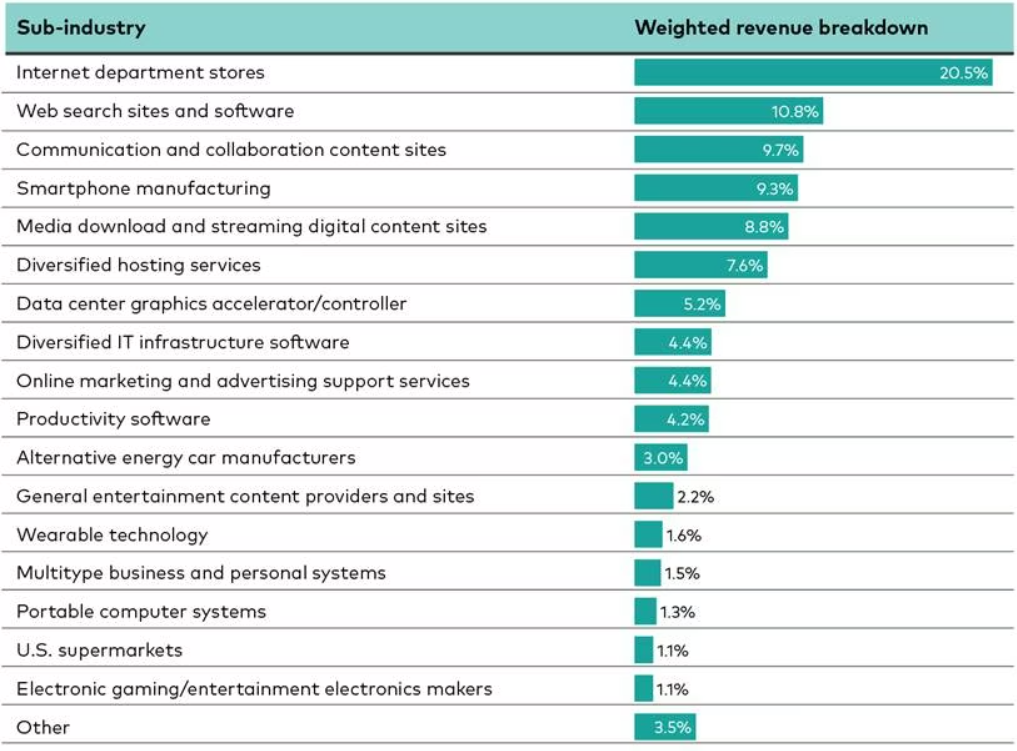
Notes: Weighted revenue breakdown is the proportion of combined revenues attributed to a given source. It is determined by aggregating the revenue from each source across companies and then dividing this figure by the total revenue from all companies combined. Revenues are based on the company’s reported annual fiscal year total revenue for 2025. Sum may not total 100% due to rounding. 

Sources: Vanguard calculations, based on data from FactSet, as of January 2026. 


Consider a few examples: 

  • Amazon: Nearly two-thirds of its revenue comes from digital mall operations, approximately one-quarter from cloud services, and the remainder from online marketing and advertising services. 
  • Apple: Half its revenue comes from smartphone sales, one-quarter from media downloads and content streaming, and one-quarter from a mix of computer hardware, cloud storage, and wearable consumer electronics.
  • Microsoft: Forty percent of its revenue comes from end-user home and office software, approximately one-third from back-end office infrastructure software, and the remainder from a mix of internet and data services, electronic gaming, and enterprise technology consulting.

While all three companies serve both consumers and commercial clients, their revenue exposures vary meaningfully across and within each company. 

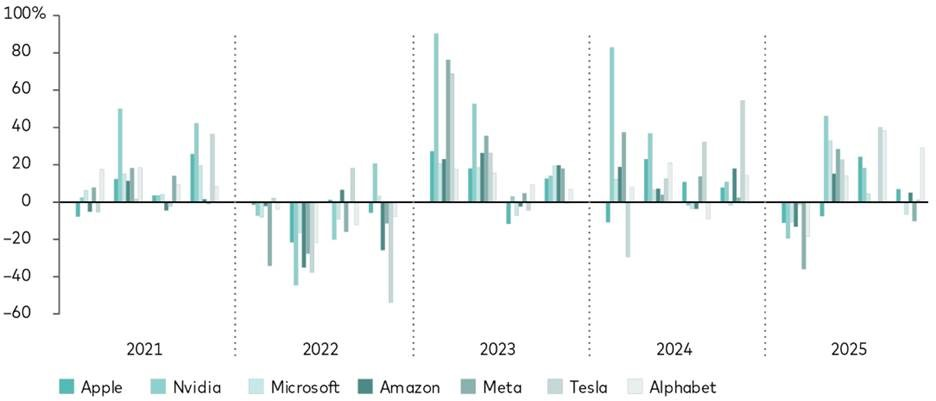
“The diverse revenue sources matter because they show that the Magnificent Seven’s business models span different end-users and markets,” said Erich Pingel, an analyst in Vanguard Investment Strategy Group. “Differences in business models also mean differences in risk-factor exposures, which helps explain why their stock prices do not move entirely in lockstep.”


The Magnificent Seven stocks have not moved in lockstep

Quarterly total returns of common stocks, Q4 2020-Q4 2025
Sources: Vanguard calculations, based on data from FactSet, as of December 31, 2025.


Seven stocks: Neither narrow nor self-contained

“The Magnificent Seven currently represents around 30% of the U.S. stock market. The companies are often portrayed as a monolith, but their business models tell a different story,” said Rodney Comegys, chief investment officer, Vanguard Capital Management, and head of Global Equity. “Their commercial and equity market success coexists with meaningful differentiation at the company level—making it unlikely that all of them will disappear or experience significant drawdowns at the same time. They share a label, not a business model.”  

For investors with long time horizons, it’s worth considering how creative destruction—the process by which innovation disrupts products, technologies, and companies—recasts market leadership. 

Comegys said that those inclined to consider the market’s evolution over short periods should recognize that market leadership often changes—and that the human tendency to expect trends to persist is just one factor that makes it hard to predict who the new winners or laggards will be or when the transition happens.

The world is more interconnected and interdependent than ever, due in no small part to technological progress. Although the Magnificent Seven share common elements, the companies and their stocks are not interchangeable. Their business models, strategies, and consumer bases vary—and so has the performance of their stock prices. 


Vanguard
15/04/2026
vanguard.com.au

Want to know more?

Do you have a question about something you've read in this article? Need more information? Want to book an appointment? Simply let us know below and we'll get back to you ASAP.

General Disclaimer

The information contained on this website is general in nature and does not take into account your personal circumstances, financial needs or objectives. Before acting on any information, you should consider the appropriateness of it and the relevant product having regard to your objectives, financial situation and needs. In particular, you should seek the appropriate financial advice and read the relevant Product Disclosure Statement or other offer document prior to acquiring any financial product.

Dr John Tickell is a registered Medical Doctor, who graduated at the University of Melbourne, Australia. Dr John has spent several decades travelling and researching the eating and living habits of the longest living, healthiest people on our planet.

The author may give opinions and make general or particular statements in this literature regarding potential changes of lifestyle habits based on experience and research. You are strongly advised not to make any changes or take any action as a result of reading or listening to this material without specific advice from your doctor, physician or registered Health Professional.

The author, the Publisher, the Editor and their respective employees or agents do not accept any responsibility for the actions of any person, or injury, loss or damage occasioned - actions which are in any way related to information contained herein.

Opinions and statements in this literature are based on verified research and experiences by the authors and are to be regarded as health and wellness advice.

Privacy Policy

What Personal Information Do We Collect?

The personal information that we collect will depend on your relationship with us and the service(s) you or your organisation have engaged us to provide or are interested in. It may include:

Name and contact information (including telephone and mobile number, email address and residential and postal address);

Individual information (including racial or ethnic origin(s), language(s) spoken, religious belief(s) and affiliation(s), date of birth, age, place of birth, gender(s), occupation(s), employment and qualification details, financial records, income details, asset listings, taxation records, bank account details, insurance policies, medical history, disability status, criminal record and Court records);

Payment and transactional information (including banking and credit card details);

Other personal or sensitive information (including information contained in communications or documents, any information required due to the nature of your matter, or information we are required to or permitted to collect by law).

Collecting Personal Information

HOW WE COLLECT PERSONAL INFORMATION

We may collect your personal information directly from you or in the course of our dealings with you. For example, we collect personal information from you or about you from:

Correspondence between you and us;

Meetings and interviews with us, telephone calls with us, the instructions you provide to us;

Visits to and submissions you make on our website;

Your interactions with our electronic direct mail and/or emails from our marketing campaigns (such as clicks on links included in these emails); and

Registration and forms you may fill in for our marketing-related activities and events.

WHY WE COLLECT, HOLD AND USE PERSONAL INFORMATION

We collect and hold your personal information for a variety of purposes, and you permit us to use it:

To provide you with our services and carry out our business functions;

For purposes related to the provision of our services such as , educational briefings, seminars and coaching and other service offering updates, conducting client satisfaction surveys and feedback requests, statistical collation and website traffic analysis;

Where you have consented to its use or disclosure;

Where we reasonably believe that use or disclosure is necessary to lessen or prevent a serious, immediate threat to someone's health or safety or the public's health or safety;

Where we reasonably suspect that unlawful activity has been, is being or may be engaged in and the use or disclosure is a necessary part of our investigation or in reporting the matter to the relevant authorities;

Where such use or disclosure is required under or authorised by law (for example, to comply with a subpoena, a warrant or other order of a court or legal process);

Where we reasonably believe that use or disclosure is necessary for the prevention, investigation, prosecution and punishment of crimes or wrongdoings or the preparation for, or conduct of, proceedings before any court or tribunal (or the implementation of orders of a court or tribunal or on behalf of an enforcement body);

To develop and improve our business, products and services; and

For any lawful purpose.

Where we wish to use or disclose your personal information for other purposes, we will obtain your consent.

HOW WE HOLD AND STORE PERSONAL INFORMATION

Your personal information is held and stored on paper, by electronic means or both. We have physical, electronic and procedural safeguards in place for personal information and take reasonable steps to ensure that your personal information is protected from misuse, interference, loss and unauthorised access, modification and disclosure:

Data held and stored on paper is stored in a secure premises.

Data held and stored electronically is protected by internal and external firewalls, high encryption and all access to electronic data including databases requires password access

Access to personal information is restricted to staff and contractors whose job description requires access. Our employees and contractors are contractually obliged to maintain the confidentiality of any personal information held by us.

We undertake regular data backups, with the data copied and backed up to multiple locations for redundancy purposes.

Our staff receive regular training on privacy procedures.